










Raise your hand if the words “cardiovascular stress test” make you want to schedule literally anything else first — a root canal, a tax audit, a trip to pick up your kid from baseball practice when it’s 104 degrees outside. I get it. Most of us in Fulshear, Katy, and Sugar Land are juggling carpool lines, work deadlines, and dinner plans that somehow always end with someone asking “wait, we’re out of bread?” The last thing on our minds is booking a treadmill test at the cardiologist’s office.
But what if I told you there’s a free, low-tech, take-five-minutes-on-your-living-room-floor way to get a meaningful snapshot of your heart health? And what if that “test” is something you probably haven’t done on purpose since Mr. Davidson’s 7th grade gym class made you do them as punishment for talking during attendance?
I’m talking about push-ups.
The firefighters who accidentally became heart health legends
Here’s where it gets interesting. Researchers at Harvard’s School of Public Health followed over 1,100 male firefighters from departments across Indiana for an entire decade. These guys are basically the definition of “occupationally active” — they’re hauling gear, climbing ladders, and occasionally running into burning buildings for a living. So if anyone’s going to give us useful data on functional fitness, it’s this crew.
At the start of the study, each firefighter did a push-up test — going for as many reps as they could in time with a metronome before either tapping out from exhaustion or losing form. Then researchers sat back for ten years and tracked who developed cardiovascular issues like coronary artery disease, heart failure, or worse.
The results? Pretty eye-opening.
More push-ups, dramatically lower heart disease risk
Guys who could knock out more than 40 push-ups had a 96% lower risk of cardiovascular events compared to the group that could barely crank out 10. Even the folks in the middle tiers — say, 21 to 30 push-ups — saw their risk drop by over 80%. And this wasn’t just a “well, younger guys do more push-ups and younger guys have healthier hearts” situation either. Researchers adjusted for age and body weight, and push-up capacity still held up as a strong, independent predictor.
Maybe the wildest part? Push-up capacity turned out to be a better predictor of future heart issues than those expensive treadmill stress tests. Let that sink in for a second. A free bodyweight exercise outperformed a piece of medical equipment that costs thousands of dollars and requires an appointment, a waiting room, and someone telling you to “just relax” while wires are taped to your chest.
Why does a push-up say so much about your heart?
Push-ups aren’t just an arm thing — despite what every gym bro on social media wants you to believe. To do one correctly, your chest, shoulders, triceps, core, and even your legs and glutes all have to work together to keep your body in a straight line while you lower and press. It’s basically a full-body coordination test disguised as an “upper body exercise.”
But the real magic is in what your push-up number reflects about everything else going on inside your body. In the study, people who could do more push-ups also tended to have lower blood pressure, healthier cholesterol numbers, better blood sugar control, lower body fat, and were less likely to smoke. In other words, your push-up count isn’t magically protecting your heart on its own — it’s more like a report card for your overall health habits.
Building and maintaining muscle (especially the big muscle groups involved in a push-up) keeps your metabolism humming, helps regulate blood sugar, and reduces inflammation throughout your body. All of that adds up to a heart that’s working under a lot less stress.
Okay, so how many push-ups should YOU be able to do?
Before you panic and start dropping for push-ups in the Costco parking lot, let’s be real — this study was done on active-duty firefighters. Most of us juggling school drop-offs, work emails, and a never-ending pile of laundry are not exactly training for the fire academy. The specific numbers (40+ push-ups for that big risk reduction) aren’t a pass/fail test for the rest of us.
What matters is the trend, not the trophy. Here’s how to try it yourself:
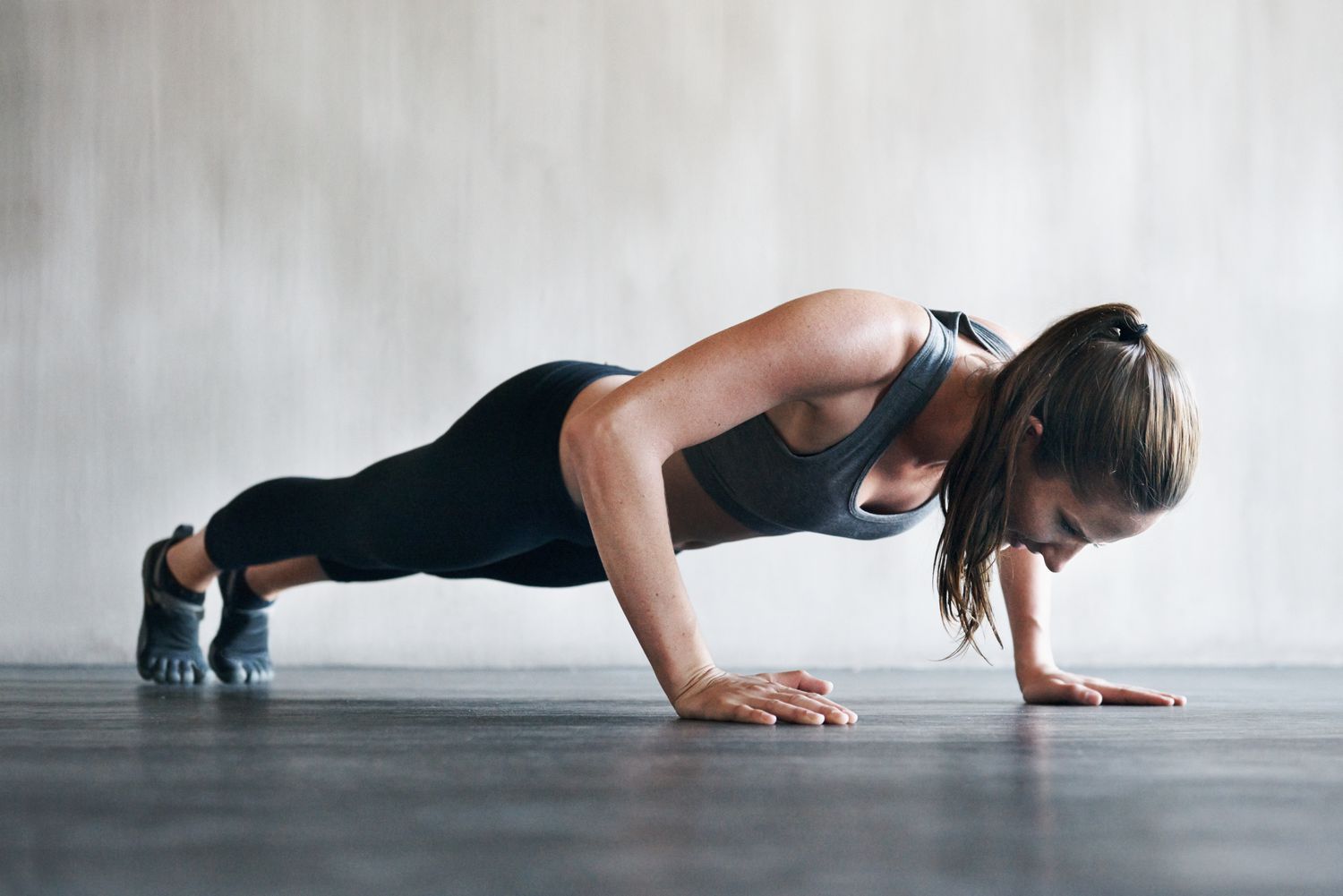
Get into a standard push-up position — hands a little wider than shoulder-width, body in a straight line from head to heels (no sagging hips, no “downward dog” booty in the air). Lower your chest toward the floor, push back up, and keep your core tight the whole time. Count how many you can do with good form before your form starts to fall apart.
Whatever number you land on, that’s your starting point — not a verdict on your life choices. If you’re already cranking out a solid number, awesome, keep building on it. If push-ups aren’t your thing yet, modified push-ups on your knees are a completely legitimate way to start building that strength. And if you can’t do a single one right now? That’s not a failure — that’s just information. It tells you exactly where to begin.
Why this matters more than ever for busy parents
Look, I know “go do a heart health check on your living room floor” sounds like the kind of thing that gets buried under a thousand other priorities. Between getting the kids to practice, making it through the workday, and trying to remember if you actually fed the dog this morning, “test my cardiovascular fitness” probably isn’t topping your to-do list.
But that’s exactly why I built the Busy Parent Health & Fitness program the way I did. It’s designed for real life — for people who don’t have two hours to spend at the gym every day but still want to build the kind of strength and endurance that protects their heart for the long haul. Push-ups (and modified variations) are baked right into the program, with progressions that meet you wherever your current fitness level is, whether that’s “I haven’t done a push-up since high school” or “I’m ready to push myself.”
And if part of your heart health journey involves cleaning up what’s on your plate (which, let’s be honest, is most of us), my recipe ebook Thin in the Kitchen is packed with simple, family-friendly recipes that won’t have you spending three hours in the kitchen after a full day of work and school pickups.
The takeaway you can actually use today
You don’t need a fancy gym membership, a $3,000 treadmill test, or a six-month waiting list for a specialist to start understanding your heart health. You need about five minutes, a clear spot on the floor, and the willingness to find out where you currently stand.
Try the push-up test this week. Write down your number. Then start building from there — a few extra reps, a little better form, a little more consistency. Your heart will thank you, even if your arms are a little sore tomorrow.
If you want a structured plan that takes the guesswork out of building that strength (and fits into a schedule that already feels packed to the brim), check out Busy Parent Health & Fitness. It’s built specifically for people who are tired of “someday” and ready for “starting this week.”